William Morris Seamless Patterns Vector
If you’ve ever admired the lush, botanical richness of William Morris’s wallpaper designs—those intricate vines, rhythmic florals, and harmonious repetitions—you know how powerfully pattern can shape mood, meaning, and memory. But replicating that timeless elegance in modern digital projects isn’t always straightforward. That’s where the William Morris Seamless Patterns Vector set steps in—not as a historical replica, but as a living, adaptable bridge between Victorian craftsmanship and today’s creative workflows.
More Than Nostalgia: A Practical Toolkit for Real Projects
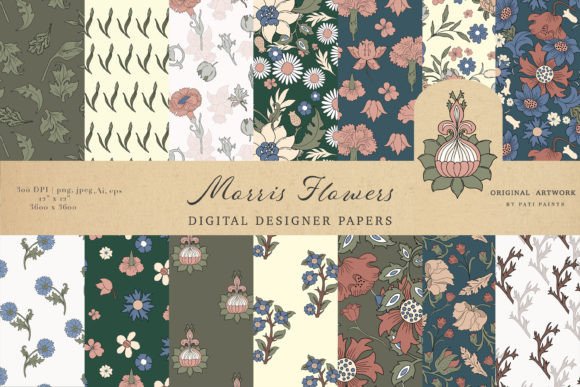
This collection delivers 14 hand-painted seamless patterns, each built on a 12×12 inch (3600×3600 px, 300 dpi) canvas—optimized for both print and digital use. What makes it distinctive isn’t just the Morris-inspired motifs—think winding ivy, clustered hawthorn blossoms, or stylized acanthus—but the consistent, personal hand behind them. These aren’t AI-generated approximations or traced reproductions; they’re original compositions that honor Morris’s principles—balance, repetition, naturalism—while retaining a contemporary warmth and subtle variation in line weight, texture, and spacing.
Each pattern is supplied in four formats: high-res JPEG and PNG for quick integration into Canva, Photoshop, or web layouts; Adobe Illustrator (.ai) files for precise editing, scaling, or color adjustments; and EPS for broad compatibility with older design software or print production systems. That flexibility means you’re not locked into one workflow—you can tweak a motif for a fabric swatch, drop a version straight into a wedding invitation suite, or extract a single element to build a custom logo mark.
Where These Patterns Solve Real Creative Challenges
Wedding designers and stationers often juggle tight timelines and client expectations for elegance without cliché. With this set, you gain instant access to cohesive, printable backgrounds that feel artisanal—not stock. A soft rose-and-fern pattern works beautifully as a liner inside an envelope, while a bolder trellis design anchors a ceremony program without competing with typography. Because all files are true seamless tiles, scaling across large-format prints (like signage or table runners) introduces no visible joins or distortions.
Fabric designers and small-batch apparel brands benefit from vector scalability—no pixelation when enlarging a motif for a full-width textile repeat. The hand-painted quality also translates well to screen printing or digital textile printing, offering subtle texture that avoids the flatness of purely geometric repeats. One designer used the “Willow & Wren” pattern (a gentle vertical rhythm of willow branches and nesting birds) for organic cotton napkins—and reported clients specifically commented on its “quiet sophistication.”
Product-based entrepreneurs—think mug shops, sticker lines, or greeting card publishers—find immediate utility here. Unlike generic clipart or overused royalty-free patterns, these carry narrative depth. A tea towel printed with the “Honeysuckle Scroll” pattern feels intentional and story-rich; a sticker sheet built from the “Meadow Sprig” motif reads as curated, not algorithmic. And because raster and vector files are included side-by-side, you can generate mockups quickly in PNG and refine production assets later in Illustrator.
Why Format Diversity Matters More Than You Might Think
Many pattern sets offer only one file type—often JPEG or SVG. That creates friction. JPEGs can’t be recolored without masking. SVGs sometimes lack embedded fonts or complex gradients needed for accurate output. This set avoids those bottlenecks. Need to match brand Pantones? Open the .ai file, select layers by motif component, and reassign colors in seconds. Preparing for offset printing? Use the CMYK-ready EPS or high-res JPEG with embedded ICC profiles. Building a Shopify product page? Drop in the crisp PNG background and adjust opacity for layered effects.
The inclusion of both raster and vector also supports accessibility in practice: designers who rely on free or subscription-light tools (like Affinity Designer or Photopea) can still use the PNG/JPEGs effectively, while professional studios retain full editability. It’s a rare balance—thoughtful inclusivity, not technical compromise.
A Note on Fit and Intentional Use
This isn’t a “one-size-fits-all” library. The patterns lean toward organic flow rather than bold geometry or minimalism—so if your brand voice is strictly tech-forward or industrial, these may sit outside your visual vocabulary. Likewise, while the 14 patterns offer strong variety (from dense florals to airy vine scrolls), they share a cohesive tonal language. That’s a strength for branding consistency—but means you’ll want to pair them intentionally with typography and photography that complement their lyrical rhythm, not fight it.
Also worth noting: these are *seamless* by construction, but not all applications require perfect tiling. For example, using a pattern at 70% scale on a business card background may soften repetition enough to feel more like texture than motif—another layer of versatility. Test at multiple sizes and opacities before finalizing; the hand-painted grain rewards close viewing but also holds up gracefully at distance.
Who Benefits Most—and Why It Sticks Around
Creative professionals who regularly produce branded collateral—freelance designers, in-house marketing teams, boutique publishers—often cite pattern libraries as among their most reused assets. But usefulness decays fast if files are hard to adapt, poorly organized, or stylistically narrow. The William Morris Seamless Patterns Vector set avoids that trap through three quiet strengths: authenticity of execution, format redundancy, and restrained scope. Fourteen patterns is enough to explore variation without overwhelming choice; the shared aesthetic ensures cohesion across projects; and the dual-format delivery removes common roadblocks in handoff and production.
Hobbyists and educators also find value—not just for finished pieces, but as teaching tools. The vector files allow students to deconstruct how negative space, stroke variation, and motif density contribute to rhythm. One textile arts instructor uses the “Blackberry Vine” pattern to demonstrate how to convert hand-drawn repeats into scalable digital assets—a tangible lesson in translation across media.
In short, this set doesn’t ask you to change your process. It meets you where you are—with files that work in your existing tools, aesthetics that resonate without demanding trend-chasing, and patterns that support intentionality, not decoration for decoration’s sake.