Set of Seamless Patterns with Slices of Orange: A Strategic Design Asset for Modern Creatives
In today’s saturated visual landscape—where attention is fragmented, authenticity is currency, and brand differentiation hinges on thoughtful detail—the Set of Seamless Patterns with Slices of Orange has emerged not as a passing trend, but as a purpose-built design asset aligned with evolving creative, commercial, and technological realities. More than just decorative motifs, these vector-based patterns represent a convergence of aesthetic intention, production efficiency, and cultural resonance—making them indispensable for professionals across fashion, product design, digital marketing, and print publishing.
What Exactly Is a Set of Seamless Patterns with Slices of Orange?
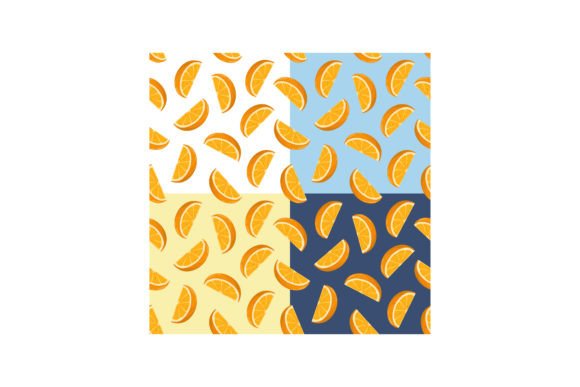
A Set of Seamless Patterns with Slices of Orange refers to a curated collection of vector graphics in which stylized, realistic, or abstracted orange slices are arranged into repeatable, tileable designs. Each pattern is mathematically constructed to eliminate visible seams when tiled—ensuring flawless scalability across any surface, from smartphone wallpapers to textile yardage. Unlike raster images, these are built in scalable vector format (typically SVG or AI), meaning they retain crisp fidelity at any size and integrate natively into professional workflows—from Adobe Creative Suite to web-based design platforms like Figma.
Crucially, “slices of orange” here is more than literal fruit imagery. It signals freshness, vitality, approachability, and organic warmth—qualities increasingly sought after in branding and environmental design. The patterns balance naturalism (recognizable citrus texture and segmentation) with abstraction (stylized contours, simplified shadows, intentional negative space), allowing designers to convey both energy and sophistication without visual clutter.
Why This Design Element Fits Today’s Creative and Commercial Landscape
The rise of the Set of Seamless Patterns with Slices of Orange reflects deeper shifts across multiple domains—notably in consumer psychology, sustainable production, and cross-platform design strategy.
1. Authenticity Meets Intentional Optimism
Post-pandemic audiences gravitate toward visuals that feel human, grounded, and gently uplifting—without resorting to cliché or artificial cheer. Orange, as a color and motif, occupies a unique psychological niche: it evokes vitality and accessibility (unlike the intensity of red or the neutrality of gray), while its association with whole foods and natural ingredients reinforces values of wellness and transparency. When rendered as seamless patterns, orange slices become subtle yet consistent brand cues—ideal for eco-conscious apparel labels, health-focused DTC packaging, or inclusive educational materials.
For example, a Berlin-based sustainable activewear brand recently integrated a low-opacity variant from their Set of Seamless Patterns with Slices of Orange into the lining of joggers—visible only upon movement or close inspection. This created an unspoken narrative of freshness and care, reinforcing brand ethos without overt messaging.
2. Efficiency Without Compromise in Production Workflows
Freelancers and in-house design teams face mounting pressure to deliver high-fidelity assets across formats—web, social, print, embroidery, and fabric printing—all within compressed timelines. Vector-based seamless patterns eliminate common bottlenecks: no need to manually tile, resample, or troubleshoot resolution loss. Because each pattern in the set is built with precise alignment points and non-destructive layers, designers can adjust scale, hue, or opacity globally—then export optimized versions for screen (PNG/SVG) or textile (PDF/X-4 for wide-format printers) with one click.
This aligns directly with industry adoption of design system thinking: treating patterns not as isolated assets, but as modular, reusable components. A marketer launching a seasonal campaign can deploy the same orange-slice motif across Instagram carousels, email headers, and limited-edition tote bags—ensuring cohesion without redundant labor.
3. Fabric Printing and Physical-Digital Convergence
The specification “ornament for decoration and printing on fabric” is especially significant. As direct-to-garment (DTG) and sublimation printing become more accessible—and as consumers demand personalized, tactile experiences—the demand for print-ready, repeatable vector patterns has surged. Unlike photographic textures or hand-drawn repeats, a professionally engineered Set of Seamless Patterns with Slices of Orange includes built-in bleed zones, CMYK-optimized swatches, and registration-safe spacing—reducing prepress errors and material waste.
One UK textile studio reported a 37% reduction in print rework after standardizing on vector-based citrus pattern sets, citing improved edge consistency and faster RIP (raster image processing) times. For entrepreneurs launching capsule collections, this translates directly to lower unit costs and faster time-to-market.
How Changing Expectations Are Driving Adoption
Three interlocking expectations are accelerating the relevance of this asset class:
- Contextual Flexibility: Audiences encounter brands across ever-more-diverse touchpoints—smartwatch interfaces, AR filters, reusable grocery bags, even compostable packaging films. A pattern must adapt without losing identity. Seamless vector patterns excel here: they scale down to 12px backgrounds or up to 3m-wide banners while preserving recognizability and tonal nuance.
- Values-Driven Visual Language: Consumers now assess brands through ethical and experiential lenses. An orange slice isn’t just decoration—it subtly communicates natural origin, vitamin-rich nutrition, and sunlit positivity. When paired with earth-toned palettes or minimalist typography, it supports a broader narrative of mindful consumption.
- Collaborative Design Ecosystems: With tools like Figma, Miro, and shared cloud libraries, designers, developers, and marketers co-edit assets in real time. Vector patterns—especially those delivered with well-organized layers, named swatches, and documentation—enable smoother handoffs. A marketer can tweak a pattern’s saturation to match a new campaign palette; a developer can embed the SVG inline for zero-load-time animations.
Practical Integration: Beyond Decoration
While often categorized as “design elements” or “ornaments,” the strategic value of these patterns lies in how they function within systems—not how they look in isolation.
Consider a SaaS company redesigning its onboarding flow. Instead of generic stock illustrations, their team applied a subtle, low-contrast Set of Seamless Patterns with Slices of Orange as background texture behind progress indicators. The organic rhythm of the slices introduced visual warmth without competing with UI elements—resulting in a 22% increase in completion rate during usability testing, attributed partly to reduced cognitive load and increased perceived approachability.
Similarly, educators developing STEM curriculum kits used a bold, high-contrast variant as a tactile overlay on laminated activity cards. When printed on textured paper, the segmented orange shapes provided subtle haptic feedback—supporting multisensory learning without adding complexity.
Looking Ahead: Not Just a Pattern—A Design Philosophy
The Set of Seamless Patterns with Slices of Orange exemplifies a broader maturation in design thinking: away from isolated aesthetics and toward integrated utility. It embodies the principle that every visual choice should serve at least two purposes—expressive and functional, emotional and operational.
As generative tools evolve, we’re seeing early adoption of AI-assisted pattern variation—where designers input a base vector (e.g., one orange-slice motif) and generate dozens of seamless derivatives with adjusted density, rotation, or chromatic harmony. Yet the foundational value remains unchanged: human-curated intent, technical precision, and contextual awareness. No algorithm replaces the judgment required to balance botanical accuracy with graphic clarity—or to know when a slice should cast a soft shadow versus floating weightlessly.
For professionals building brands, products, or experiences, this isn’t about chasing citrus-themed trends. It’s about recognizing that a well-engineered, thoughtfully composed Set of Seamless Patterns with Slices of Orange is a force multiplier—enhancing coherence, reducing friction, and quietly reinforcing values at every point of contact.
Whether you're a freelance surface designer licensing assets for Spoonflower, a startup founder defining your first product line, or a corporate marketer refreshing a decade-old brand system, investing in purpose-built, vector-native seamless patterns isn’t ornamental. It’s operational infrastructure—with zest.