Midnight Bloom Floral Patterns: Versatile, High-Resolution Digital Papers for Creative Professionals
When you’re designing wallpaper for a boutique hotel lobby, printing custom wrapping paper for a luxury skincare brand, or developing a signature fabric collection for a slow-fashion label—quality, flexibility, and mood matter. That’s where the 6 Midnight Bloom Floral Patterns step in: not just as decorative assets, but as deeply functional creative tools built for real-world production needs.
What Makes These Patterns Stand Out?
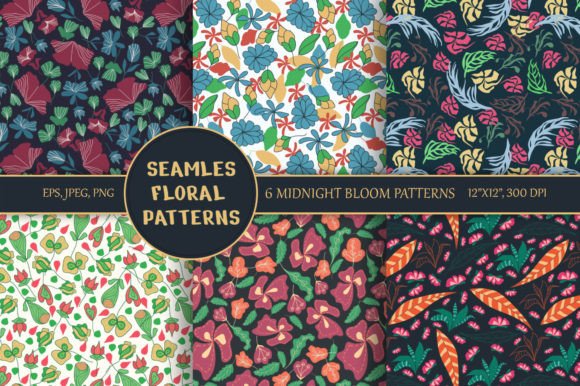
These aren’t generic floral repeats pulled from a stock library. Each of the 6 Midnight Bloom Floral Patterns is an original, hand-crafted vector design rooted in botanical elegance and nocturnal sophistication—think deep indigos, charcoal greys, muted violets, and soft ivory blooms against rich, velvety backgrounds. The “midnight” tone isn’t literal black; it’s atmospheric, dimensional, and intentional—designed to evoke quiet luxury, calm intensity, and timeless refinement.
More importantly, they’re engineered for versatility. Every pattern is delivered in three formats—vector EPS, high-res JPEG, and transparent PNG—each sized precisely at 3600×3600 pixels and optimized for 300 DPI output. That means whether you’re scaling a motif across a 10-foot wallpaper panel or shrinking it down for a monogrammed notecard, clarity holds. No pixelation. No distortion. No last-minute panic before print.
Why Vector + Raster Coverage Matters (and When to Use Which)
Let’s break it down practically:
- EPS files are your go-to for scalability without compromise. Need to stretch one of the 6 Midnight Bloom Floral Patterns across a 20-yard bolt of silk? Resize it for a laser-cut acrylic invitation suite? Adjust individual petals or stems in Illustrator? EPS gives you full editability—paths, layers, colors—all intact.
- JPEG files shine in layout-heavy workflows. Drop them straight into InDesign for stationery mockups, Photoshop for texture blending, or Canva for quick social media banners. Their 3600×3600 resolution ensures crispness even when zoomed or layered with overlays.
- PNG files unlock transparency—critical for digital mockups, web use, or overlaying on photos, gradients, or colored substrates. Want that midnight rose motif to sit softly over a cream linen swatch photo? PNG makes it seamless.
This triple-format approach eliminates format-hopping guesswork. You’re not converting or resampling—you’re selecting the right tool for the job, every time.
Fabric & Textile Design: Precision Meets Print Readiness
For textile designers, repeat integrity is non-negotiable. A misaligned tile can ruin yardage, waste dye, and delay production. Each of the 6 Midnight Bloom Floral Patterns is built as a true seamless repeat—tested and refined so edges align invisibly at any scale. They’re constructed on a clean 12×12 inch tile base, making them compatible with industry-standard textile platforms like Spoonflower, Printful, and Contrado.
Real-world example: A small-batch apparel brand used the “Lunar Vine” pattern (one of the six) for a limited-run line of organic cotton scarves. Because the vector file retained perfect registration at both 12-inch sampling and full-width roll printing, their first production run matched the digital proof down to the petal curve—no costly reprints, no client revisions.
Wallpaper & Interior Surfaces: Depth Without Complexity
Modern wallpaper isn’t just about coverage—it’s about atmosphere. These patterns deliver visual richness without visual noise. The midnight palette recedes subtly, letting architecture breathe while still anchoring a space with intention. Unlike overly busy florals that compete with furniture or art, the 6 Midnight Bloom Floral Patterns offer rhythm, not clutter.
Interior designers report using them for feature walls in wellness studios, boutique lobbies, and residential studies—especially where acoustics, lighting, and materiality converge. Because each JPEG and PNG is 3600×3600 px, they integrate cleanly into visualization tools like SketchUp, Enscape, and Adobe Dimension. No stretching. No tiling artifacts. Just accurate, immersive previews clients approve on the first round.
Stationery & Packaging: Where Tone Meets Tactility
Think beyond the envelope. These patterns elevate unboxing experiences, gift tags, foil-stamped business cards, and letterpress wedding suites—not because they’re ornate, but because they’re considered. The subdued color range ensures legibility over printed text, while the fine linework translates beautifully to embossing, debossing, or spot UV.
One independent stationer shared how she layered the “Nocturne Fern” pattern (another of the six) as a subtle watermark behind minimalist typography on recycled kraft paper. The result? A tactile, sophisticated identity that felt personal—not mass-produced. That’s the power of starting with a pattern designed for subtlety, not saturation.
Wrapping Paper & Retail Applications: Functionality First
Great wrapping paper does two things: protects *and* communicates. These patterns do both. At 3600×3600 px, each file prints flawlessly on standard 24×36 inch sheets—ideal for craft printers or local print shops. The 300 DPI resolution ensures ink density stays consistent across large surface areas, so deep tones remain rich, not muddy.
Small retailers love them for seasonal collections—especially autumn and winter—because the midnight palette feels grounded and elegant, not festive or fleeting. And since all six patterns share a cohesive tonal language (but distinct silhouettes), brands can rotate motifs across product lines without losing visual continuity.
Workflow Integration: Fast, Clean, and Cross-Platform Friendly
You don’t need niche software to use these. Whether you’re in Affinity Designer, Figma, Procreate (with imported PNGs), or even Google Slides for pitch decks—the files behave predictably. No font dependencies. No linked assets. No hidden layers or locked groups.
The 12×12 inch vector tile size also aligns with common print-on-demand canvas dimensions, meaning less resizing, fewer alignment checks, and faster turnaround from concept to physical sample. For freelancers juggling multiple clients—or in-house designers managing tight deadlines—that consistency saves hours per project.
What to Consider Before You Choose
Not every floral pattern suits every use case—and that’s okay. Ask yourself:
- What’s the primary substrate? Fabric demands seamless precision. Wallpaper benefits from larger-scale rhythm. Stationery often works best with finer detail.
- Will this be edited post-purchase? If you plan to recolor, isolate elements, or animate parts of the design, prioritize the EPS files.
- How much visual weight does the space or product need? A bold, high-contrast bloom may overwhelm a delicate ceramic label—but shine on a velvet cushion.
- Is brand cohesion part of the goal? All six patterns share a unified palette and botanical sensibility, making them ideal for building a family of related designs—not just one-off uses.
And yes—these are digital papers, not physical swatches. But their resolution, construction, and thoughtful color balancing mean what you see on screen reliably translates to print. That predictability reduces risk, builds confidence, and lets you focus on storytelling—not troubleshooting.
Final Thought: It’s Not Just About Flowers—It’s About Intention
The 6 Midnight Bloom Floral Patterns reflect a shift in how creatives source assets: less “filler,” more foundation. They’re not background noise. They’re quiet collaborators—supporting tone, reinforcing identity, and elevating execution across industries. Whether you're launching a capsule collection, redesigning a hospitality space, or crafting a memorable client gift, these patterns give you room to breathe, create, and commit—without compromise.