Lime Seamless Patterns & Citrus Papers: High-Resolution Digital Textures for Versatile Creative Work
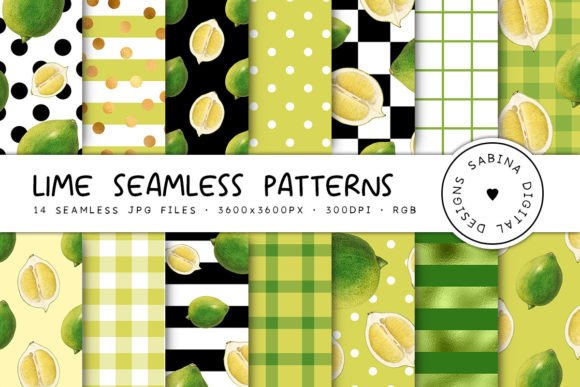
Designers, educators, product developers, and small business owners increasingly rely on high-fidelity digital surface textures—not just as decorative accents, but as functional assets in branding, packaging, instructional materials, and physical production. Among the most adaptable resources in this category are Lime Seamless Patterns and Citrus Papers: a curated set of 14 meticulously crafted, print-ready JPEG files designed to bridge digital creativity with real-world application.
What Makes These Files Distinctive?
Each file in the collection is delivered as a 3600×3600 pixel JPEG—ensuring crisp fidelity across both screen and print. At 300 DPI and 12″×12″ print dimensions, they scale cleanly to full-page layouts, large-format signage, or precision-cut craft templates without interpolation artifacts or visible pixelation. Unlike low-resolution web patterns or generically tiled vectors, these are hand-refined seamless patterns built around organic citrus-inspired palettes—think zesty lime zest, sun-warmed grapefruit rind, and translucent mandarin membranes—translated into repeatable, edge-to-edge surface designs.
The color mode is RGB, optimized for screen-based workflows (web design, UI mockups, digital presentations) while retaining sufficient tonal range for professional CMYK conversion when needed. This dual-readiness means educators can embed them directly into interactive lesson slides; packaging designers can test label prototypes at true size; and textile artists can preview how motifs translate onto fabric swatches—all without reformatting or color shifting.
Product Development & Packaging Design
For startups launching food-related products—cold-pressed juices, artisanal marmalades, or eco-conscious cleaning supplies—Citrus Papers offer immediate, contextually resonant texture options. A matte-finish label for an organic lime-infused sparkling water gains authenticity when layered over a subtle, fibrous citrus pulp pattern. Similarly, a reusable produce bag brand might use a light lime grid pattern as a watermark background on hangtags—reinforcing sustainability through visual metaphor rather than overt text.
Because each pattern is truly seamless, designers avoid visible tile boundaries even when scaling to wrap around curved surfaces like bottles or cylindrical tins. This eliminates time-consuming manual blending or cloning—saving hours during prototyping phases where rapid iteration matters.
Educational Materials & Visual Learning Tools
In classrooms and online courses, texture enhances cognitive anchoring. A biology instructor illustrating plant cell structure might overlay a semi-transparent Lime Seamless Pattern beneath a labeled diagram of citrus fruit cross-sections—creating intuitive visual continuity between concept and source material. Language teachers building vocabulary flashcards for food-related terms can use distinct citrus paper variants (e.g., a stippled kumquat skin vs. a glossy blood orange gradient) to differentiate semantic categories—leveraging perceptual fluency to support memory retention.
These files integrate effortlessly into learning management systems (LMS), Canva templates, or Adobe Express projects. Their consistent 12″×12″ dimension simplifies batch resizing for printable worksheets, laminated reference cards, or tactile classroom displays—no cropping or aspect-ratio guesswork required.
Small Business Branding & Marketing Collateral
Local cafes, farmers’ markets, and wellness studios often operate with constrained design budgets but high expectations for visual cohesion. With Lime Seamless Patterns, a café owner can unify their Instagram feed, menu board, and takeaway cup sleeve using variations of the same underlying motif—perhaps a soft lime leaf lattice for digital posts and a bolder, higher-contrast citrus pith pattern for printed coasters. Consistency emerges not from rigid logo repetition, but from shared textural language.
Crucially, these files require no licensing negotiations or attribution. They’re ready for commercial use—ideal for solopreneurs generating branded merchandise (tote bags, notebooks, enamel pins) via print-on-demand platforms that accept JPEG uploads. No vector conversion, no font embedding issues, no transparency complications.
Technical Advantages Beyond Resolution
While resolution and color mode are foundational, three less-discussed attributes elevate this collection’s utility:
- Edge Integrity: Each pattern undergoes manual seam inspection—not automated tiling. This ensures zero ghosting, misaligned nodes, or unintended contrast shifts at tile boundaries, even under magnification or tight crop margins.
- Tonal Versatility: The 14 files span a deliberate spectrum—from near-monochrome parchment textures with faint citrus fiber hints to vibrant, saturated lime-green repeats. This range supports both minimalist aesthetics (e.g., a whisper-thin lime vein pattern on ivory stock) and bold applications (a dense, overlapping citrus slice motif for festival banners).
- Workflow Agnosticism: Whether you work in Figma, Affinity Designer, Procreate, or Google Slides, these JPEGs behave predictably. No plugin dependencies, no raster-to-vector translation errors, and no embedded profiles that trigger unexpected color warnings in older software versions.
Real-World Considerations for Implementation
Adopting high-resolution seamless patterns isn’t merely about dropping files into a layout—it’s about aligning technical properties with intended output. Here’s what practitioners should keep in mind:
Print Production Readiness
Although delivered in RGB, these files convert reliably to CMYK for offset or digital printing—provided your printer accepts RGB input or you perform conversion using perceptual rendering intent (not saturation). For best results on uncoated stock, reduce overall pattern opacity by 5–10% to prevent ink saturation; on metallic or pearlescent substrates, pair lighter citrus papers with foil stamping for dimensional contrast.
Digital Interface Optimization
On websites or apps, avoid using full-size 3600×3600 JPEGs for background elements. Instead, export lightweight WebP or AVIF derivatives (1200×1200 or smaller) with modern compression. Retain the original high-res files only for print handoff or archival purposes. This preserves performance without sacrificing final output quality.
Accessibility Integration
When used as backgrounds behind text, ensure sufficient luminance contrast. Lime-based patterns with mid-tone values (e.g., #A8C926 overlays) generally pass WCAG AA contrast thresholds against dark type—but always verify using browser developer tools or dedicated contrast checkers. For users relying on screen readers, apply appropriate ARIA labels if the pattern conveys meaningful information (e.g., “Citrus fiber texture indicating natural ingredients”).
Why Seamless Texture Libraries Matter Now
The rise of AI-generated imagery has heightened demand for authentic, human-curated surface qualities. Algorithms excel at photorealism but often falter with nuanced texture repetition—producing patterns that look “almost right” until inspected closely. Lime Seamless Patterns and Citrus Papers respond to this gap: they’re grounded in tangible reference (actual citrus specimens photographed under controlled lighting), refined through iterative manual adjustment, and validated across physical outputs.
This isn’t nostalgia for analog processes—it’s recognition that certain creative decisions benefit from intentional curation over algorithmic generation. When a children’s book illustrator selects a gently mottled lime skin pattern for a cover about sensory exploration, they’re choosing specificity over generality. When a university lab designing citrus-based bioplastics uses the same pattern in grant proposal visuals, they’re reinforcing thematic continuity across disciplines.
Getting Started Without Overcomplication
You don’t need advanced software to begin. Open any file in Preview (macOS) or Photos (Windows), copy it, and paste into PowerPoint or Keynote—the 12″×12″ canvas maps cleanly to standard slide sizes. In Canva, upload and set as background; adjust transparency sliders to blend with brand colors. For physical prototyping, print one file at actual size on cardstock, cut into 2″ squares, and arrange them on a mood board to assess rhythm and scale before committing to full runs.
Because all 14 files share identical dimensions and color space, swapping between variants mid-project introduces zero technical friction. Need a warmer tone for holiday packaging? Replace the cool-lime grid with a golden-orange peel variant—same placement, same layer settings, same export workflow.
Long-Term Value Beyond Immediate Use
Unlike trend-dependent assets, citrus-inspired textures possess enduring relevance. Botanical motifs consistently rank among the most universally recognized visual cues for freshness, vitality, and natural origin—backed by decades of consumer research across food, wellness, and personal care sectors. Citrus Papers distill that resonance into reusable, scalable components—not as fleeting trends, but as foundational elements in a sustainable visual vocabulary.
Moreover, the collection’s consistency enables longitudinal projects. An educator developing a multi-year citrus agriculture curriculum can introduce patterns incrementally—starting with simple identification (e.g., “Which image shows citrus pith?”), progressing to texture analysis (“How does this pattern suggest moisture content?”), and culminating in student-generated pattern extensions. The files become teaching tools, not just decoration.
Ultimately, Lime Seamless Patterns and Citrus Papers succeed because they resolve practical constraints—resolution mismatches, color inconsistencies, tile artifacts—while leaving room for intentionality. They don’t prescribe how to design; they remove barriers to doing it well, across contexts as varied as a kindergarten classroom, a boutique packaging studio, or a university extension program on sustainable horticulture. That balance of technical rigor and creative flexibility is what makes them persistently useful—not just today, but across evolving tools, platforms, and pedagogies.