Patterns of Decorative Branches
If you’ve ever spent hours searching for a botanical pattern that feels both elegant and grounded—rich in detail but never overwhelming—you’ll recognize the quiet power of Patterns of Decorative Branches. This isn’t just another digital foliage asset. It’s a thoughtfully composed, high-fidelity design system built for creators who value intentionality in texture, contrast, and repetition.
What Makes These Branch Patterns Stand Out
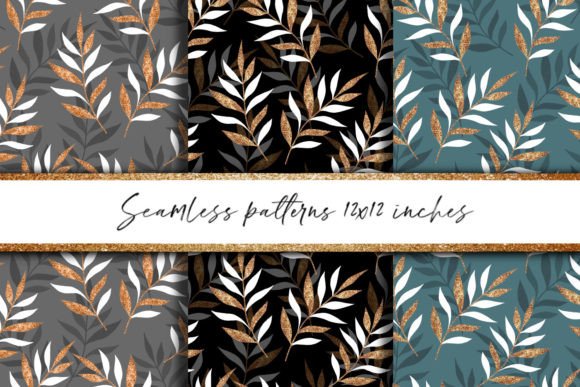
At its core, Patterns of Decorative Branches delivers three meticulously crafted JPG files—each 3600×3600 pixels, 300 dpi, and optimized for print and digital fidelity. But resolution alone doesn’t tell the story. What sets these apart is how the elements interact: delicate greenery layered with subtle gold leaves, fine gold glitter accents catching light without dominating, and a deep black background that makes every organic curve and metallic shimmer pop with clarity.
The patterns are seamless—tested across tiling boundaries so they scale effortlessly from business card size to wall mural dimensions. Unlike many “botanical” designs that lean heavily into soft pastels or chaotic wildness, this collection balances structure and spontaneity. The branches follow natural growth rhythms—some arching, others curling inward—but never feel random. That intentional rhythm translates directly into usability: fewer edits, less time spent masking or adjusting repeats.
Real-World Uses You’ll Reach For Again and Again
Whether you’re designing wedding stationery for a luxury boutique or prototyping packaging for an eco-conscious skincare line, Patterns of Decorative Branches adapts without compromise.
- Invitations & Paper Goods: Print crisp letterpress-style cards or foil-accented envelopes—the black base ensures rich ink coverage, while gold elements translate beautifully to spot UV or metallic foil stamping.
- Fabric & Surface Design: Seamlessly tile across scarves, tote bags, or wallpaper mockups. Because the repeat is tight and balanced, it avoids visual fatigue even at large scales—a common pitfall with overly dense foliage patterns.
- Digital Presentations & Brand Assets: Use cropped sections as elegant slide backgrounds, social media banners, or email headers. The contrast between gold and black adds sophistication without sacrificing readability.
- Educational & Workshop Materials: Teachers and workshop leaders use these as tactile backdrops for printable flashcards, lesson plan templates, or student project rubrics—especially in nature-themed units or design thinking curricula.
- DIY & Gift Wrapping: Print on kraft paper or vellum for custom wrapping—pair with twine and dried florals for cohesive gifting. The high resolution means no pixelation when scaled down for small tags or up for large banners.
Why Resolution and Seamlessness Matter More Than You Think
It’s easy to assume “high-res” just means “looks good on screen.” But in practice, 3600×3600 at 300 dpi gives you real flexibility—not just for print, but for future-proofing. Need to extract a single branch as a vector-ready element? You can crop and retrace cleanly. Want to overlay text or logos without worrying about moiré or blurring? The sharp edge definition holds up. And because each file is a true seamless repeat (not just a cropped square), you avoid those awkward “jump” lines when scaling across fabric bolts or website hero sections.
That seamlessness also saves time during production. No more manually adjusting tile offsets in Illustrator or wrestling with Photoshop’s pattern preview lag. Drop it in, set your repeat, and move on—whether you’re prepping for offset printing or exporting a Shopify product mockup.
How Designers Actually Integrate These Into Their Workflow
Freelancers often start by importing one pattern into their brand board library—not as a final design, but as a texture reference. They’ll sample the gold tone to build a custom swatch, then pull the darkest green for secondary typography or icon outlines. Others use the black background as a built-in “matte,” layering transparent PNG illustrations directly over it without needing extra masking steps.
Small-business owners report using the patterns most for packaging consistency: same motif on shipping labels, thank-you cards, and product tags—even when printed by different vendors. Because the files are JPG-based (not PSD or layered), they’re universally compatible across platforms like Canva, Adobe Express, Affinity Designer, and Cricut Design Space.
Things to Keep in Mind Before You Use Them
While versatile, Patterns of Decorative Branches works best when aligned with your project’s tonal goals. Its refined contrast and gold accents naturally lean toward elevated, timeless, or artisanal aesthetics—not playful, minimalist, or ultra-modern branding. If your palette includes bright neons or heavy sans-serif typography, test contrast first—some gold tones may need slight brightness adjustment to maintain legibility.
Also note: these are digital papers—not editable vectors. You won’t find isolated leaf paths or customizable color sliders. That’s intentional. They’re designed as finished, production-ready surfaces—not starting points for illustration. If your work requires granular path editing, pair them with complementary vector foliage packs rather than expecting full modularity here.
A Thoughtful Tool, Not Just Another Download
Good design assets don’t shout. They support. They simplify decisions. They reduce friction between idea and execution. Patterns of Decorative Branches does exactly that—offering depth without clutter, elegance without pretense, and versatility without vagueness.
Whether you’re hand-lettering a birth announcement, developing a textile line, or building a course on sustainable design, these patterns serve as quiet collaborators—grounded in nature, refined through craft, and built for real work.
And if you’re evaluating similar assets, ask yourself: Does it hold up at 200% zoom? Does the repeat vanish at the edges? Does the contrast support both serif and sans-serif typography? Does it feel like something you’d want to use again next month—not just today? With Patterns of Decorative Branches, the answer tends to be yes, across projects, platforms, and seasons.